Quality control guide | For installers, inspectors and project owners
A uniform seam appearance alone is insufficient for accepting a geomembrane weld. Traceable handover requires a test plan, seam identification, inspection results and resolution of repairs. This guide explains the control structure and handover records; equipment settings and acceptance criteria must follow the product, welding method and approved project specifications.
At the preconstruction meeting, assign responsibility for testing and approval, define how results are recorded and establish how nonconformities will be handled. Review sample forms before welding starts. Product specifications, roll numbers and panel layouts must be reconcilable with site records. Establish clear procedures for stoppages, restarts and changes in installation conditions.
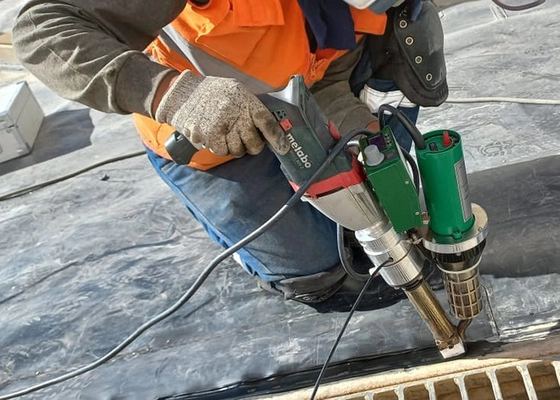
Construction quality control, or CQC, is generally within the installer’s responsibility. Construction quality assurance, or CQA, checks conformity with drawings and specifications and is often performed by an independent party. Define both roles in the contract. An inspector’s presence does not remove the installer’s obligation to record and correct the work; an installer’s report does not replace the review required by the quality assurance plan.
| Control group | General purpose | Important limitation |
|---|---|---|
| Visual inspection | Identify discontinuities and visible defects | Insufficient on its own for acceptance |
| Nondestructive testing | Check seam continuity using a suitable method | The method must suit the seam and project conditions |
| Destructive testing | Assess joint properties in a removed sample | The sampling location must be repaired and tested under the approved procedure |
| Repair verification | Record repairs and retest results | Each repair must link to the original seam and location |
Air pressure testing of dual-track seams with an air channel and vacuum box testing of extrusion welds are common methods. Destructive tests can assess seam shear and peel strength. Do not apply one generic value for test selection, sampling intervals, pressure, duration or acceptance limits to every product and project.
A test report should allow the seam location to be found on the drawing. Link seam identification, adjacent panels, date and time, operator, equipment, recorded environmental conditions and test results in one traceable chain. If a seam was completed in several stages, show the working and stoppage intervals.
Mark the location, define the investigation extent under the quality plan and obtain corrective action approval from the authorized person. Performing a repair alone is insufficient to close a nonconformity: record post-repair verification and final status. Show the repair on the final drawing. Resolve differences between site and laboratory reports before handover.
| Record | Handover check |
|---|---|
| Product documents | Do roll numbers match the shipment and installed panels? |
| As-built drawings | Can seams, pipe penetrations and repairs be identified? |
| Test reports | Are the method, location, result and approver clear? |
| Corrective action register | Have all open items been resolved? |
| Handover minutes | Are the accepted scope and outstanding items defined? |
Check quality plan hold points and approvals before covering the liner or filling the pond. Product delivery, acceptance of welding work and authorization to operate are separate decisions; assign responsibility for each. Adapt this suggested checklist to the project contract and quality plan.
Does a leak test replace seam strength testing? These checks have different purposes. The approved plan specifies the necessary tests.
Is there one fixed welding machine setting? No. Sheet, equipment and environmental conditions must be incorporated into the approved installation procedure.
Can a report be accepted without seam drawings? Results are difficult to trace without a clear link to their installation location. Define the acceptance format and minimum records in the contract from the outset.
Send the drawings, project location, application and required specifications to the sales team at Polyethylene Gostaran Alborz so that a product supply proposal with a clear scope can be prepared. Project specialists are responsible for design and installation details.
Contact PEGA for consultation and a quotation
See also the pond installation cost guide.
Solmax — How to perform proper quality management on geomembranes, for the CQC/CQA distinction and groups of tests. The documentation tables are suggested working tools provided by this guide.